Monday, January 31, 2011

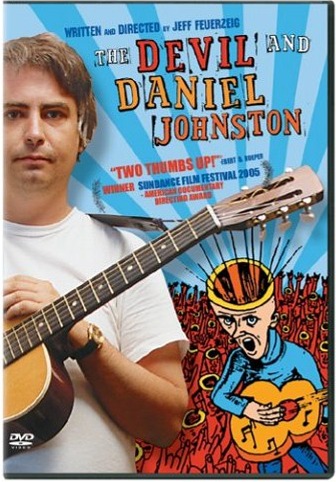
A Documentary in Review: The Devil and Daniel Johnston

Intro and Overall Idea:
The Devil and Daniel Johnston is a biographical documentary about the singer, songwriter and artist Daniel Johnston. While Daniel Johnston was never a pop-music icon he collected quite a fan base of individuals with his strange, scattered, and often brilliant albums and mix-tapes. Daniel's best asset was his ability to be raw, real, and poetic. Within the documentary, his mother spoke of his talent to self-educate himself with musical instruments, and his highschool friend talked about how impressed and jealous he was that Daniel seemed to just innately be an artist. He was able to draw intricately and "Daniel started out good, and just seemed to get better," his friend said fondly about Daniel's artistic side.

This film progresses chronologically, with little to no effects used during the film. The content of the documentary itself is interesting, Daniel Johnston is one of those artists that seem to live in his or her own head, like Andy Warhol or Sylvia Plath. The film focused on anecdotes told by the different people that had encountered and at one time befriended Daniel Johnston. Although I wasn't a huge fan of his music at the beginning, by the end of this film I enjoyed Daniel's music and find him incredibly interesting.


Shooting Style and Effects:
The footage of The Devil and Daniel Johnston is a combination of Daniel's own raw footage, shots of places the people in the film are talking about and footage of Daniel's work. Homemade movies were a large part of Daniel's childhood, as he experimented with artistic mediums outside of music. I found this footage to be a great addition to the film, especially when his own mother was speaking how she felt about some of the movies. Although I found this footage interesting, it was only at the beginning of the film because it progressed chronologically and Daniel had filmed less as he got older.

Within the film, there are hardly any effects used. There were no fancy transitions or treatments used on the footage. The only effect I can think of is some of Daniel's drawings being animated during on of his songs. I thought this was interesting, but the animated segment with the music over-top was too long for me. I can understand however that they were showcasing Daniel's music as well as art, and it did work in part as a transition to the next segment.

The film moved in segments, chronologically following Daniel's life. It began with his childhood, moved on to his first love, told the story of his flirtation with fame and finally ends with modern-day Daniel. I found one of the most interesting parts of the film the relation between Kurt Cobain and Daniel Johnston.

Interview Style:
The interviews were taken at various locations, most seemed impromptu with little to no professional lighting. The filmmakers seemed to be limited in the number of cameras and resources they had, so they relied more on what the subjects had to say and provided cuts to b-roll instead of different angles of shots. Occasionally shots would be more close-up or from a different angle, but I think that there was only one camera shooting the documentary.
What is most interesting is that the filmmakers chose not to put in any commentary from present-day Daniel Johnston. The film began with footage of one of Daniel's concerts, the circle completing at the end with Daniel finishing the performance and speaking to some friends backstage. I thought the end of the movie was interesting, the footage was of Daniel dancing. While it was weird, it was endearing and raw, and that combination can pretty much sum up the entire documentary and Daniel himself.

Audio and Music:
The transitions between the stages of Daniel's life are filled with his recorded music from that point in his life. While I wasn't a huge fan of the music at first, it eventually grew on me, I was especially taken by the lyrics. Daniel wrote his own song lyrics and I found a lot of them to be really poetic, he always seemed to tell a story. Almost all of the music in the film is Daniel's, it's easy to see that he recorded a lot. This subject is touched on when Daniel recorded tape after tape, album after album, in his cousin's garage. I found it interesting the willpower and determination that Daniel had to make it as an artist.

The audio of the film is okay. While there is no narration, audio from many of the interviews is taken and dubbed over b-roll footage. I found this to be effective, it allowed for a story to be told by several different people. A lot of the sound on some of Daniel's early recordings is poor because he recorded it onto a tape in an extremely amateur style recording studio.

Subject Matter:
I found the subject matter to be portrayed in an extremely interesting manner. Although I had never heard of Daniel Johnston before, he is now fascinating and interesting to me. I am not sure if I would listen to his music but his story is definitely one worth telling. He's definitely a little bit more than offbeat, a little bit more than a misunderstood artist, but that's part of the intrigue. He was a little Warhol-esque in that some people in the film seemed to allude that Daniel made himself into the artist that he was, he wanted to feel heartbreak and to be weird, that was his goal.

Another thing that I found interesting was that Daniel had an obsession with drawing eyes. He would draw scenes with eyes as the characters, this reminded me of the recently popular film Superbad. It definitely crossed my mind that Daniel Johnston may have been the inspiration for the character's obsession with drawing only one part of the body.

Resolution:
The ending of the film was of course predictable in a chronological biographical documentary; to show Daniel Johnston modern day. This footage I found a little unsettling. Daniel appeared as if he hadn't progressed past his teenage years, this might have been part of the decision of the filmmakers not to include any footage or audio from Daniel. I felt that the end completed the film really well, showing Daniel at his most raw and vulnerable form. This film is one that you have to be in the mood to watch, but if you are, it's interesting. I personally enjoy learning about people who aren't the norm, I'm not a huge fan of the Cinderella story. This is the kind of story that I enjoy much more. Although it's not as riveting or educational as some documentaries, I would recommend this film as a great example of a biographical documentary.

Friday, January 28, 2011

A Documentary in Review: Straight Outta L.A.

Intro and Overall Idea:
What do the former L.A. Raiders and hip-hop music have in common? Take these two things and add in appearances from Ice Cube, Snoop Dogg, and Al Davis...now mix it all together and we end up with the documentary, Straight Outta L.A. This film was one of 30 documentaries shot by Hollywood film makers for ESPN, Ice Cube being one of the more recognizable celebrities on the list.

The film begins with the film's creator, Ice Cube, narrating an anecdote from his childhood of the Raiders. During the narration, the shots bounce between popular players at the time and the city of Los Angeles. Immediately the viewer can tell that Ice Cube has what the kids are calling "swag" these days, in other words, prepare yourself to see some real style and an exclusive point of view on the documentary topic coming from Mr. Cube himself. This point of view is passionate and emotional at points, especially when Ice Cube speaks of the LA riots. This section of the documentary becomes the climax of the film, demonstrating the spiral that LA had taken. Ice Cube pairs this chaos of LA side-by-side with the decision of the Raiders to leave the city and return to Oakland again.

In terms of subject matter, at first I was unsure of how the Raiders and NWA or football and hip-hop were connected. I feel like the documentary may have taken too long to do a segment on how football relates to hip-hop and the musical part was introduced much later into the film. At the same time, it is understandable to see why this happened, as the film was chronological, defined by the events occurring in Ice Cube's life.

Effects and Shooting Style:
The style of this documentary is very modern, clean, and still manages to stay a little edgy. The interviews taken were almost all shot in a brightly lit, white space, allowing the viewer to focus solely on the interviewee. The shots of the interviews were nice, with great depth, shadow and contrast of the subjects. There was a good mix between close-up shots to show emotion, and comfortably off-center angled shots. The cameramen took the opportunity to film some nice details, one of my favourite shots in the interviews was a close-up on Al Davis's NFL bracelet. These kind of detail shots during an interview are a newer technique, but I quite liked the use of it in this documentary.

The shots of Ice Cube were almost all moving shots, most with Snoop Dogg present in a conversation-style interview. This was my least favourite part of the documentary, I think Ice Cube's questions were phrased so that Snoop Dogg could only answer in agreement with Ice Cube...which is boring and predictable for the viewer. It also felt like an awkward set-up, with them playing a game of catch with a football in the empty stadium (I'm assuming the former Raiders stadium?). These segments seemed mostly useless, Ice Cube's commentary was present enough in the film because he narrated the entire film.

Keeping with the theme of negativity, the interview sections of Al Davis were...terrible. While Davis may have had great things to say, he was just unattractively lit, and a little creepy to look at. This was the only interview that wasn't brightly lit with a white background, instead Ice Cube chose a dark blue-gray backdrop for the interview. This only added to the creepy effect the interview had. I think that Al Davis had a lot to say, but it would have been more comfortable to watch b-roll footage with his voice narrating over-top of it. I wouldn't have minded short cuts to Davis himself to show emotion and to keep the viewer interested, but I found the constant, poorly lit shots of Davis to be both boring and unsettling.

The treatments used on the b-roll footage and stills were definitely modern. Most of the still photos were converted from 2D to 3D, this was an effect I haven't seen used very much. Some of the b-roll footage was actually an animation of Ice Cube's childhood and career, providing some comic relief. I have seen this technique used in other documentary films such as Michael Moore's popular film, Bowling for Columbine. The animation itself was simple, black and white drawings with characters that were overly expressive. I enjoyed these animated parts because I think they helped to transition from one point in Ice Cube's story to another with a short and comical narration instead of a long explanation. In all honesty, I found the animations to be charming.


Music and Audio:
Of course Ice Cube takes the opportunity to demonstrate his taste in hip-hop music, providing appropriately upbeat tracks to both transitions and b-roll footage between segments. Obviously NWA's music is featured more than once, as is their style. Narration is one of the most important aspects of this film, and I feel that the script provided to Ice Cube was well written. Ice Cube has a good amount of emotion and high-low rise in his voice to keep the viewers interested. There is nothing worse than a monotone speaker, so it's a plus that Ice Cube is able to be expressive off-camera with his voice as well.

Emotion and Conflict:
Throughout the film, there was a gradual rise as the Raiders move to LA and begin to win. But with every up, there's always a down. The writers did a great job here providing a high-low feeling to the story of the Raiders. Going into the powerful, dark climax of the documentary, Ice Cube brings up a heavy topic: the LA drug trade. This transition and relation to the Raiders was powerful and when it was coupled with darker b-roll footage and stills. Not only was this transition from light to dark done well, but it was properly synced with some more intense rap/hip-hop music, it caused the viewer to feel unsettled. Ice Cube's demeanor behind the camera became serious as he narrated the LA Riots. I felt that this was the most emotional and powerful part of the film. Usually documentaries build up, but they do not have such a huge rise and fall like Straight Outta LA did. I thought it was unique!

Resolution:
I found the resolution of this documentary to kind of leave the viewer wanting to ask questions and follow football. After reading that this documentary was a part of a project by ESPN, it makes sense that they would want to leave interest with the viewer about football. ESPN, being a popular sports network, wouldn't mind a few extra viewers during the NFL season I'm sure.

Another thing I was left wondering after the documentary was, how did Ice Cube really feel about Al Davis? He appeared to be a fan of Davis throughout the film, but then attacked him in a couple parts, I wasn't sure what Ice Cube's final thoughts on Davis were. I would have been interested to know if Ice Cube though that Al Davis was greedy, or a man just doing what was best for his team?

Sidenote:

I just found this...it's definitely relevant to a course focused on technology. I thought this was ridiculous, I can't imagine what teenagers 20 years from now will think....


Thursday, January 27, 2011

Grade 8 Interviews

This is Alex and my project that we created to demonstrate our sit-down interview skills (and work with lighting as well). Our video includes some B-footage, music, and some audio work. We had a microphone the day of but after taking it home and dumping the audio onto a computer we realized we only had it for about half the kids. So that was one technical difficulty, the camera audio just did not work well at all. Another technical difficulty was the cameras, for some reason they were occasionally out of focus. Ah well, you live and you learn, if we re-did this kind of project, we'd know what to look for going wrong next time. As for the positive, I think our roaming B-footage camera during the interviews looks great, some of the kids were easy to talk to and I think the editing is done well with what footage and opinions we had. So without further adieu, here it is...


Final Project Video

Our group made two videos for our final project, one for grade 8 night and a 30 second short as well! :) While we all agree it would have been nice to have had more time to take footage of more of what gdci has to offer, we think we pulled off the video in the short amount of time given. Props to Chapin, Gina, Graham, and Spencer for all working together to make this fun video.

Long Version:


30 second Short:

Wednesday, December 8, 2010

My Song

So I've completed my song on Garageband but have yet to complete the slideshow of personal pictures to it. You know how it goes, set up a day when you aren't working to have a photo shoot and it rains. Then the next it snows. Then you decide to take pictures at the coffeehouse but it's canceled due to poor weather. Nice...I mean I'm not making excuses, I'm just blaming mother nature. :) So the slideshow will get put up soon when I figure out something interesting enough to do an entire slideshow of pictures on. In the meantime, you can enjoy my song without a slideshow, just to know that I've got part of the project done and the other half is in the works.


A Song in Review - We Own the Sky by M83


If ever a time should arise where you are craving a song to fill your longing for modern, yet tastefully nostalgic 80s sounds, then we have the perfect prescription for you. M83’s hit (We Own the Sky) is the song that you’ll want to indulge in, over and over again. Released in December 2008, We Own the Sky has become one of the latest spotlight songs of the popular indie band, M83. And by band we mean…Anthony Gonzalez. Yes, that’s right folks, another shy dream-pop band fuelled by one man. But before you write M83 off as that stereotypical band that hipsters tend to use and abuse, we ask that you give M83 a fighting chance.

Anthony Gonzalez, creator of M83, is a French musician who dreams of going back to the days when life seemed simpler. And what was simpler than being a teenager? On his newest album Saturdays=Youth it’s easy to see this nostalgic attitude mirrored in the simple synth sounds, electric guitars, and drum beats. Gonzalez says, “To do that, we tried to work only with instruments from the ‘80s…We worked only with analog keyboards, analog synths; we didn’t use any computers. The idea is to have a very ‘80s sound, but modern as well.” So where does this modern sound come from you ask? We found the answer was as beautifully simple as this album itself, through the unique and haunting vocals.

We Own the Sky begins with heavy, repetitive synth chords. Underneath the chords is a fluid sounding beat that avoids overwhelming the chords. Together the duo creates a sense of floating, freedom, even a wave-like pattern. Enter the vocals: light, shy, unique. Reminiscent of the unique vocal styling’s of Sigur Ros, M83’s sound can only be described as unique. Coincidentally enough Saturdays=Youth was recorded with the help of Ken Thomas who has also worked with Sigur Ros, The Sugarcubes, and Suede. There is a certain feeling that the listener hears in Gonzalez’s voice and to us it is shyness, adding in a shoegaze element to M83’s already diverse sound. Gonzalez himself has admitted to taking risks with this album and one of those risks was using vocals more than in previous albums. We applaud his confidence and hope to hear more of his shy, inspirational, and fluid voice in his future releases.

The lyrics themselves are fascinating, poetic and cryptic enough to keep the listener intrigued,

Secrets from the winds,
Burnt stars crying,
So many moons here,
Lost wings floating.

The words are poetic to say the least. We love the feeling that the lyrics of the song bring. It's almost a fading feeling, infinite floating, blissfully perfect. They fit right in with the beat, tempo, and rhythm of the song itself. While the lyrics become repetitive after some time, there’s something soothing that can be found when these words are repeated in a chant-like form. Gonzalez has created an anthem for his listeners, easily heard and deeply felt. Just like the song, the lyrics are slow and powerful, they touch your core. If this song doesn’t remind you of freedom, youth, and a warm meadow, you might need psychological help.

Gonzalez says he’s happy with the success that he’s had in North America with his music but what he really wants now is some recognition in France. “…With bands like Daft Punk or Air, they were really first famous in America and then after that they came back to France and had lots of success. So, maybe it will be the same thing for me,” says Gonzalez about his hopes for the future. We feel that if he keeps producing albums and songs as moving and deep as We Own the Sky, how could he not become a sensation in his hometown? There’s no doubt that we’re rooting for you Anthony, humming along to your beautiful, nostalgic, inspirational song all day, every day. Because We Own the Sky.